
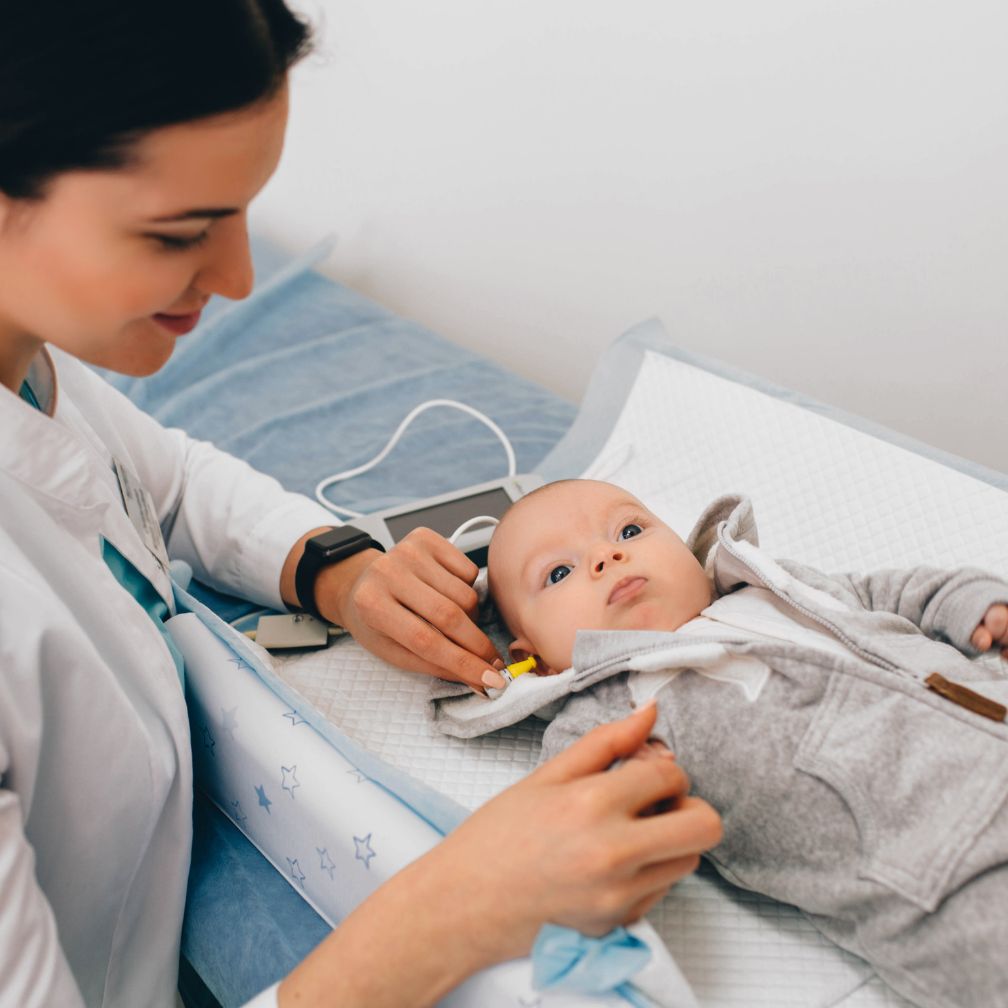
For guardians caring for an infant, understanding that their baby exhibits auditory deficits tends to spark heavy emotional dread. However, the optimistic truth remains that via rapid evaluation and proper care, babies experiencing hearing issues are able to flourish. Clearly, such children consistently gain core language skills, social capabilities, and firm bonds with people in their lives, building toward a prosperous life!
Combining traditional hearing devices with specialized cochlear technology provides two highly successful solutions for supporting infants who exhibit hearing loss. Down below, we investigate how both instruments operate to enable you to choose which technology best serves your youngster.
Understanding Infant Hearing Loss
Hearing loss in infants routinely stems from a wide array of factors, including:
- Random genetic variations (even across lineages lacking hearing loss history)
- In-utero viral infections including cytomegalovirus (CMV) and rubella viruses
- Acute complications during birth, including lack of oxygen or premature birth
- Specific clinical medications given during neonatal intensive care stays
What stands as the primary clinical priority? Early medical diagnosis. Owing to these factors, infants delivered in United States hospitals complete hearing screens prior to heading home. Respected pediatric hearing experts implement the recognized “1-3-6” target timetable:
- Primary hearing check administered within 30 days of birth
- Officially diagnosed within 90 days of life
- Clinical intervention (utilizing hearing aids or therapy) started prior to 180 days of life
Reaching these clinical benchmarks grants babies an ideal foundation for strong speech, linguistic, and brain development. If you require additional direction surrounding screening protocols, your pediatrician will be happy to assist you!
Wearable Hearing Aids in Infant Care
For young children demonstrating mild to severe hearing challenges, custom hearing aids usually act as the primary solution. Specialized, ear-level instruments amplify ambient sound, helping babies hear human speech and environmental sounds with far greater precision.
Customized infant hearing instruments operate as:
- Proven safe for infants as young as a few weeks old
- Engineered featuring soft, flexible ear impressions that adapt smoothly during physical growth
- Furnished with child-resistant battery compartments and specialized pediatric safety components
- Uniquely adjusted by a trained pediatric hearing practitioner to match your child’s exact hearing needs
As your baby grows, wearable hearing devices demand ongoing updates to maintain physical comfort and functional efficacy.
Understanding Cochlear Implantation for Babies
Should an infant present with severe to profound sensorineural hearing loss and demonstrates limited success with standard amplification, medical teams often recommend a cochlear implant. Unlike standard acoustic hearing aids, cochlear implant systems:
- Need to be installed via an outpatient surgical procedure within the patient’s inner ear
- Safely bypass damaged structures of the inner ear system
- Change ambient sound waves into direct electrical impulses that directly excite the acoustic nerve
Pediatric cochlear implant systems remain:
- Fully cleared by the FDA for young children starting at 9 to 12 months of age
- Uniquely successful when paired with early therapy and family support
- Recommended exclusively following detailed multi-disciplinary testing performed by an audiologist alongside an ENT physician
That pre-surgical path incorporates high-resolution imaging, advanced hearing evaluations, and setting realistic expectations for future communicative success.
Evaluating Hearing Aids Against Cochlear Implants
- Mild to severe hearing loss relies on Hearing Aids; Severe to profound hearing loss requires Cochlear Implants
- Non-Invasive: Hearing Aids; Invasive (Surgical): Cochlear Implants
- Physical sound amplification: Hearing Aids; Direct electrical signal generation: Cochlear Implants
- Treatment starts in newborn infancy: Hearing Aids; Implantation starts at 9-12 months: Cochlear Implants
Final Conclusions: Selecting the Right Path for Your Infant
If your newborn faces a confirmed hearing impairment diagnosis, you can rely on excellent technological options and dedicated expert support. Thanks to collaboration with dedicated pediatric audiologists, countless infants successfully cultivate language skills that are on par with their peers.
Whether your youngster qualifies for external hearing aids or surgical cochlear implants, acting swiftly creates a profound lifelong advantage.
Have questions about your baby’s hearing health? Reach out to us today to receive a complete diagnostic assessment and personalized rehabilitation plan.